

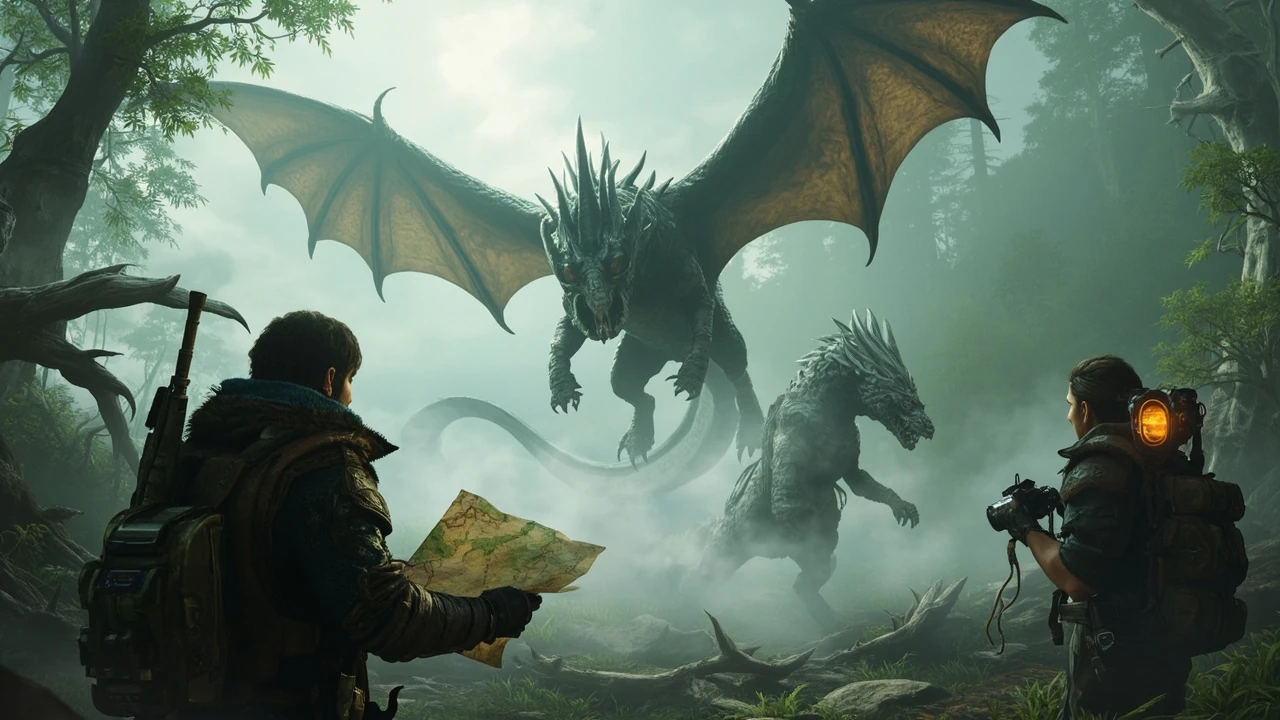
Monster Hunter World monsters as a design system
Anyone who has spent serious time with Capcom’s action RPG quickly stops thinking of Monster Hunter World monsters as a list of creatures to slay. They are a combat design system. Each entry in the bestiary defines a set of attacks, a status profile, a hitzone layout, a territory, a reward table, and a behavioral state machine that the player learns by observation rather than by reading a manual. For a developer, designer, or technical artist, the roster is one of the clearest public examples of how a small studio can build a deep combat loop out of relatively few enemy archetypes, layered with ecology, AI, and a tightly tuned damage pipeline.
This guide treats the bestiary as a production artifact. It walks through the roster structure, the way monsters are authored as state machines, the role of hitzones and elemental values, how quest design reuses the same creatures across the experience curve, and where the Iceborne expansion extends that system. The goal is to give an experienced reader a working mental model of how Monster Hunter World monsters are designed, built, and balanced, rather than another checklist of “what to hunt next.”
How the Monster Hunter World monster roster is organized
The base game ships with a deliberately small set of large monsters relative to the amount of content it generates. That ratio is itself a design choice. Capcom’s team, led by series director Kaname Fujioka and then-brand-new director Yuya Tokuda, built the base roster around a small number of flagship “main story” monsters, then filled in the low- and high-rank experience with subspecies, variants, and endemic life. The same skeleton and animation rig is reused across many of those entries, with new moves, hitzones, and rewards layered on top.
For a developer reading the roster, the structural layers are easy to see once you start looking for them:
- Flagship story monsters that anchor each hub and act as gating bosses.
- Mid-tier monsters that fill the open-world map and the optional quest list.
- Subspecies and variants that share a base skeleton but change elemental affinity, hitzone values, and reward tables.
- Endemic life that share a behavioral model with large monsters but are tuned for capture, gathering, or environmental interaction rather than combat.
- Arch-tempered and event variants introduced through free title updates, which retune existing monsters rather than introducing new skeletons.
That layered structure is what lets a relatively modest large-monster count produce hundreds of hours of quests. Every layer is a multiplier on the same authored asset.
Flagship monsters and the story arc
The story progression in Monster Hunter World is built around a small number of flagship monsters that gate access to new maps and new difficulty tiers. Zorah Magdaros acts as the tutorial-scale encounter that teaches players to fight something larger than themselves, both literally and mechanically. The narrative then escalates through regional apex monsters like Rathalos in the Ancient Forest, Diablos in the Wildspire Waste, and Legiana in the Coral Palace, before converging on Xeno’jiiva as a final cinematic encounter.
For a designer, the interesting detail is that these flagship monsters are not mechanically the hardest creatures in the game. Their role is to introduce a new pattern of behavior, a new terrain interaction, or a new sense of scale. The actual difficulty curve lives in the optional and post-game monsters layered on top of the same ecology.
Subspecies and variants as a design shortcut
Subspecies and variants are the most efficient authoring tool in the system. They share a base skeleton and most of the animation set with an existing monster, but they have a different elemental affinity, a different weakness profile, and a recolored reward tree. Pink Rathian, Azure Rathalos, and Black Diablos are the most visible examples in the base game; the Iceborne expansion pushes this further with monsters like Fulgur Anjanath and Viper Tobi-Kadachi.
This approach keeps production costs predictable while still giving hunters a reason to revisit the same hunts. For technical artists, it also concentrates the most expensive work on the base model and lets lighter teams handle variations, which is a useful pattern for any production that needs content throughput without a proportional increase in art budget.
How a Monster Hunter World monster is authored as a state machine
Every large monster in Monster Hunter World is, under the hood, a finite state machine running on the game’s MT Framework engine. Each state bundles an animation, a hitzone configuration, a damage multiplier, a set of possible transitions, and sometimes an environmental interaction. The transitions are triggered by player actions, by elapsed time, by hit thresholds, or by scripted quest events.
Looking at the roster through that lens is one of the fastest ways to understand why a hunt feels readable. A monster does not “decide” to do a new attack because the player surprised it. It transitions from a locomotion state into an attack state because a timer, a damage threshold, or a positional rule fired. The player can read those triggers if they pay attention.
Common state categories
Although the specific data tables are not public, the high-level state categories are consistent across the roster and observable in normal play:
- Idle and locomotion states, which include walking, trotting, and flying for wyverns.
- Agro states, which raise aggression, change attack probability, and often unlock a more dangerous move set.
- Enrage states, which increase movement speed, change attack patterns, and sometimes apply a damage-up modifier.
- Tired or exhausted states, which the player can force through stamina damage, often opening a topple window.
- Sleep, paralysis, stun, and other status-induced states, which temporarily override the AI’s normal transitions.
- Fleeing or area-change states, used to push monsters between map regions and to script story beats.
The interesting design decision is that the same state can be entered through multiple paths. Enrage, for example, can come from a damage threshold, a turf war between two monsters, or a specific environmental trigger, and each entry point preserves the same visual cue so that hunters learn one rule and apply it everywhere.
Turf wars and shared AI
One of the more distinctive authoring patterns in Monster Hunter World is the use of shared AI to drive turf wars. When two large monsters occupy the same region, the system can evaluate relative threat, territory, and a small random factor, then transition both creatures into a scripted interaction that damages both of them and resolves a territory change. For the player, this looks like world-building. For a designer, it is a way to make ecology emerge from AI without writing bespoke encounter scripts for every map cell.
Damage, hitzones, and the combat pipeline
The Monster Hunter World combat loop is built on a pipeline that runs from a player’s weapon swing to a damage number on the screen, and every monster in the game is authored against the same pipeline. Understanding that pipeline is what separates a guide written for players from one written for developers.
Hitzone values and elemental values
Each large monster carries a hitzone table: a per-part multiplier array that defines how much physical damage each body part takes from cutting, impact, and shot damage, plus an elemental value per part for each element. The head is usually the highest-damage zone for cutting weapons, the tail is often the cut-and-sever zone, and the legs typically offer low multipliers but high stagger potential. A new monster is balanced by tuning that table, not by writing new code, which is why subspecies and variants can ship quickly while still feeling distinct.
That separation is also why a guide that lists “weakness” numbers without context is misleading. The numbers matter, but the player’s weapon class, sharpness, and the quest’s hit-count rules all sit between the table and the actual damage dealt.
Status buildup and the part-break system
On top of raw damage, every monster carries a part-break table that tracks how much damage each wound has absorbed and when it severs, cracks, or breaks. Breaking a part is not just a damage optimization: it is a quest reward gate and a visual storytelling tool. Severing a Rathalos tail, breaking a Diablos horn, or cracking a Glavenus shell changes the monster’s available moves and tells the player, in mechanical terms, that they are winning the hunt.
Quest design, ecology, and the open world
Monster Hunter World was the first entry in the series to use a seamless open world with regional maps instead of discrete arenas. That structural change reshaped the way monsters are authored. Each region has a defined population, a territory map, and a sleep/wake cycle. Monsters move between regions, eat, drink, fight, and sleep inside the same simulation that the player traverses, which means the same authored creature can deliver very different experiences depending on when and where the player engages it.
How maps multiply a small roster
The five base-game regions, each with its own climate, endemic life, and monster population, multiply the value of every creature in the roster. A Rathian fight in the Ancient Forest at night, with a Legiana passing overhead and a small monster reacting to the player’s presence, is mechanically the same hunt as a daytime arena quest, but the pressure and the available information are different. The map is doing encounter-design work that older Monster Hunter games had to do with arena scripts.
| Region | Climate and terrain | Representative apex | Encounter-design role |
|---|---|---|---|
| Ancient Forest | Dense canopy, vertical layers, waterways | Rathalos | Vertical combat and tracking through layered cover |
| Wildspire Waste | Arid open plains, dunes, and water corridors | Diablos | Long sightlines and underground ambushes |
| Coral Palace and Rotten Vale | Reef heights and decaying carcass valley | Legiana and Odogaron | High-mobility aerial fights and tight corridor chases |
| Elder’s Recess | Volcanic corridors, crystal chambers | Nergigante | Tutorial-scale elder-dragon pacing and spike damage |
| Hoarfrost Reach (Iceborne) | Snowfield and frozen caverns | Velkhana | Cold-status pressure and new clutch-claw hooks |
The encounter-design role column in that table is the one a developer should pay attention to. Each region exists to test a different subset of the combat system, and the apex monster is the final exam for that subset. When you design a new region in your own project, asking “what combat question does this place force the player to answer” is often more useful than asking “what monster fits the biome.”
Tracking, scoutflies, and the research loop
Monster Hunter World replaced the older paintball and tracking systems with scoutflies: a particle-based system that gradually reveals a tracked monster’s footprint, scuff mark, and other traces as the player follows them. Mechanically, scoutflies are a way to give players a structured investigation phase without forcing them to read quest text. From a design perspective, the more interesting choice is that the scoutfly level increases as the player gathers traces, and the visual density of the swarm tells the player, at a glance, how close they are to their target.
For a designer, the lesson is that a “tracking” feature does not have to be a UI overlay. It can be a piece of authored content that lives in the world and changes the player’s relationship to space. The same system also opens up the ecology layer: a monster’s footprints, droppings, and feeding traces are placed by hand, and many of them are reused across subspecies to keep the authoring cost down.
The Iceborne expansion as a system stress test
Iceborne is the largest piece of post-launch content Capcom shipped for Monster Hunter World, and from a system-design point of view it functions as a stress test of the original roster. It adds the Clutch Claw, a new weapon move that lets the player slingshot onto a monster and tenderize a wound. That single addition forces every monster in the game to be rebalanced, because the new wound state changes stagger timing, part-break thresholds, and the value of every existing weapon move that interacts with a tenderized part.
For a developer, the Iceborne expansion is a case study in how a small change to a player’s options can invalidate years of balance work, and how that work has to be redone in waves. Some monsters were updated in the expansion itself, others were adjusted in free title updates, and a few were left in a state the community still argues about. That arc is a useful reference for any project that plans to extend an action-RPG system past its original release.
New monster archetypes in Iceborne
Iceborne also introduces monsters that push the original authoring rules in useful ways. Velkhana layers ice-element pressure on top of the existing wyvern skeleton. Banbaro and Tigrex deepen the brute-wyvern and fanged-beast archetypes. Glavenus uses a heat-up mechanic that changes its move set based on how recently it has swung its blade tail, which is an example of a state-machine behavior that is also a visible world story. Each of those entries is a useful reference for how a system can be extended without rewriting the base engine.
How Monster Hunter World monsters shape the player-facing experience
None of the design choices above matter if the player cannot learn them. One of the quiet strengths of Monster Hunter World is that it teaches the roster through failure rather than through tutorials. A new hunter will die several times to a Great Jagras or a Barroth before they realize that the monster’s state machine is readable and that the right tool choice, the right positioning, and the right timing will close the fight.
The roster is also tuned so that the player’s weapon choice changes the meaning of the same hunt. A greatsword player and a hunting horn player are reading the same state machine, but they are prioritizing different states, different hitzones, and different stagger windows. The monsters do not change. The way the player is allowed to read them does, which is a useful pattern for any PvE game that wants a single encounter to support multiple legitimate play styles.
Player-facing reference: base-game large monsters at a glance
The table below summarizes the base-game large monsters that most new players will encounter. The “encounter role” column describes the design question the monster is meant to ask, not a difficulty rating, because the system is intentionally readable rather than punishing.
| Monster | Archetype | Encounter role | Notable authoring detail |
|---|---|---|---|
| Great Jagras | Small fanged beast | First real combat tutorial | Swallow state models the “stolen meal” world story |
| Kulu-Ya-Ku | Bird wyvern | Tool interaction tutorial | Uses rocks and eggs as authored props |
| Barroth | Brute wyvern | Mud-state transition tutorial | Elemental state changes weakness on contact |
| Jyuratodus | Piscine wyvern | Aquatic terrain tutorial | Uses mud and water states for coverage |
| Tobi-Kadachi | Fanged wyvern | Verticality and paralysis tutorial | Sliding locomotion is a state, not a cutscene |
| Anjanath | Brute wyvern | Fire-element baseline fight | Aggressive state is loud, not just stronger |
| Rathian and Rathalos | Flying wyverns | Aerial-combat and fire-element flagships | Shared skeleton, separate move sets and fireballs |
| Diablos | Flying wyvern | Underground ambush encounter | Dig state is fully authored, with tracking cues |
| Legiana | Flying wyvern | Long-flight, low-ground pressure | Air-state timers feed back into ground attacks |
| Odogaron | Fanged beast | Aggressive dual-state predator | Two-tier enrage models feral behavior |
| Great Girros | Small fanged beast | Paralysis-status tutorial | Pack call triggers authored swarm behavior |
| Radobaan | Brute wyvern | Bone-and-bug ecology tutorial | Scavenger behavior is visible in idle states |
| Uragaan | Brute wyvern | Defense and counter-state tutorial | Sleep gas from jaw is a state-driven attack |
| Lava area monsters | Brute and flying wyverns | Heat and stamina pressure | Environmental status applied through authored triggers |
| Nergigante | Elder dragon | Aggression spike tutorial | Spike regrowth state is a balance lever, not just a visual |
| Teostra and Kushala Daora | Elder dragons | Elemental pressure flagships | Aura states modify weakness and move priority |
| Vaal Hazak | Elder dragon | Effluvium and healing-state fight | Authored debuff field forces gear decisions |
| Xeno’jiiva | Elder dragon | Final-story spectacle encounter | Phase transitions replace standard enrage rules |
| Zorah Magdaros | Elder dragon | Cooperative siege tutorial | Authored quest progression lives in the monster’s state graph |
Reading that table as a designer, the pattern is clear. Almost every “new player” monster is a tutorial for a single system, and almost every flagship is a stress test for two or three systems layered on top of each other. The bestiary is the curriculum.
How to read a Monster Hunter World monster like a developer
If you want to extract design lessons from the roster rather than just play through it, a useful working method is to treat every hunt as a small reverse-engineering exercise. The steps below are the ones I find most useful when studying Monster Hunter World monsters, and they generalize to any PvE action game built on a state-driven enemy AI.
- Pick one monster and ignore the quest text. Watch it run through its normal patrol and attack loop in a free hunt or in an arena, and write down the distinct states you can identify by visual cue alone.
- List the transitions you can identify. Some of them will be time-based, some will be position-based, and some will be damage-based. The exact list is not important; the point is to notice that there is a list.
- Map the hitzone table in your head. Pick a weapon class you usually do not play and ask what a hunt with that weapon would look like against the same monster. If the answer is “completely different,” the monster is doing its job.
- Look for ecology moments. Turf wars, sleeping monsters, feeding monsters, and monsters reacting to endemic life are authored content, not random behavior. Note which moments the game uses to teach the player without telling them.
- Compare the monster to a subspecies or variant. The differences between base and variant are the levers the design team pulled to retune an encounter, which is a useful way to read design intent.
- Cross-reference the monster with the gear tree. The rewards and the difficulty curve are the same data, viewed from two sides, and the relationship between them is one of the clearest signals of intent in the entire game.
That exercise is more useful than memorizing monster-by-monster counters, because it builds the kind of vocabulary you need to evaluate any PvE action game, not just Monster Hunter World.
Why a small roster can carry a large game
The single most important production lesson in the Monster Hunter World bestiary is that content throughput comes from system depth, not from raw asset count. Capcom’s team shipped a relatively small number of unique large monsters in the base game, then extended the same roster through subspecies, variants, layered ecology, and crafted quest content. The Iceborne expansion did the same trick at a larger scale, adding a new region, a clutch-claw mechanic, and a roster of new apex monsters without rewriting the core combat system.
For a developer or studio lead, the take-away is that the cost of a PvE action game is dominated by the system layer, not the enemy layer. If the system is good, you can ship fewer enemies and still produce a long-tail experience. If the system is shallow, no amount of enemy variety will save the campaign. The Monster Hunter World bestiary is one of the cleanest public examples of that principle in practice, which is why it remains a useful reference years after release.
For readers who want a player-facing breakdown of the same roster with stat tables and recommended gear, the Game8 Monster Strategy Guides index for the base game is a useful companion. The English-language Wikipedia article on Monster Hunter World also gives a reliable production-history overview and links to the Iceborne expansion entry, both of which are useful for grounding the design discussion above in the actual release timeline.
Frequently asked questions
How many large monsters are in Monster Hunter World?
The base game ships with around thirty large monsters across five regions, with additional monsters added through free title updates and a much larger roster added by the Iceborne expansion. The exact count changes as Capcom backports or adjusts content, so it is safer to think in terms of “base roster plus Iceborne roster” than a single number.
What is the difference between a subspecies and a variant in Monster Hunter World?
Subspecies share a base skeleton and most animations with a parent monster but have a different elemental affinity, a different hitzone table, and a recolored reward tree. Variants are a broader category that includes subspecies but also covers monsters with new moves or significant behavioral changes, such as the Radobaan and Uragaan variants added through updates.
How does Monster Hunter World teach new players to read monster behavior?
The game relies on authored visual cues, audio cues, and short opening cinematics rather than long tutorials. The scoutfly system gives the player a structured way to track a target, and each early hunt introduces one new system, such as mud states, paralysis, or sleep, so that the player builds a vocabulary one monster at a time.
Why are elder dragons treated as a separate category from regular large monsters?
Elder dragons are not a fixed biological class. The game uses the label for monsters that do not fit the regular wyvern, brute, or fanged archetype and that need special quest handling, including arena quests, multi-phase encounters, or environmental phases. The category is a quest-design and balance label as much as a lore label.
How does the Clutch Claw change the way Monster Hunter World monsters are balanced?
The Clutch Claw, introduced in Iceborne, lets the player tenderize a wound, which temporarily raises the damage a part takes and softens a monster’s balance. That single addition forced a rebalance of the entire base-game roster, because tenderized wounds change stagger timing and the value of every existing weapon move that interacts with a wound.
What is the role of endemic life in the Monster Hunter World bestiary?
Endemic life is the game’s term for small creatures that share the same AI framework as large monsters but are tuned for capture, gathering, or environmental interaction rather than combat. They give the open-world maps a sense of ecology and act as soft tutorials for the gathering and crafting systems without forcing the player to read instructions.
Are Monster Hunter World monsters reused between the base game and Iceborne?
Yes. Iceborne is built around a layered extension of the base-game roster. Most of the base-game large monsters appear in the new region and in Master Rank quests, often with new moves, new hitzone values, and new gear rewards. The expansion uses the same authoring pattern of subsystem reuse that defines the base game.
What can a game designer learn from the Monster Hunter World bestiary?
The clearest lesson is that a small, well-authored enemy roster can carry a long campaign if the underlying state machine, hitzone system, and quest framework are designed to be reused. Designers can also study how the game layers ecology, AI, and reward tables to give a single creature very different roles in different quests without rewriting its behavior.

Leave a Reply