

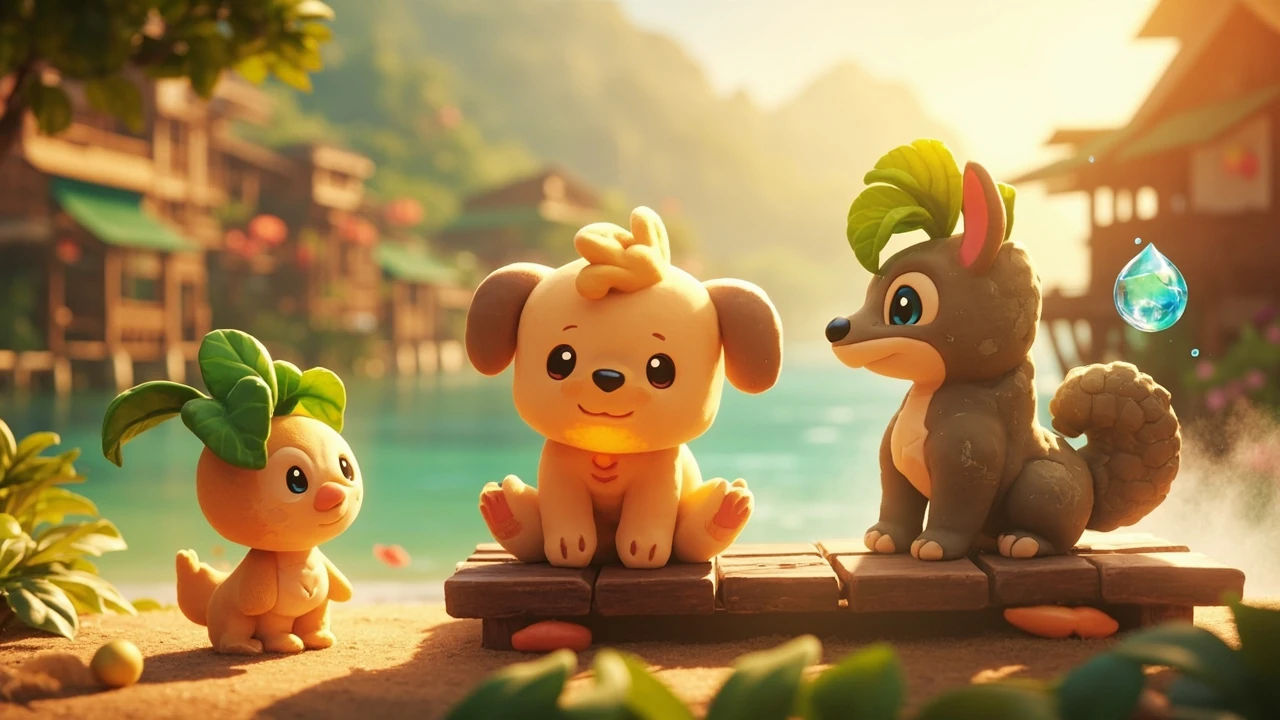
Wind and Waves starters: how to read the Browt, Pombon, and Gecqua choice
The three wind and waves starters announced for the upcoming Pokémon project are the Grass-type Browt, the Fire-type Pombon, and the Water-type Gecqua. If you have ever picked a starter in a mainline game, you already know the shape of this decision: a triangle of types that the early game will constantly pull you toward, with the rival system and early route design quietly rewarding one type while leaving the others for later content. What is different this time is the regional framing. The setting that has been teased for the project borrows heavily from Southeast Asia and Oceania, and the official descriptions lean on the kind of small, familiar animal you might actually see in a tropical town rather than on a creature designed to feel mythological.
That regional framing matters because it changes how the wind and waves starters will be balanced. A Grass-type that visually echoes a domestic chicken, a Fire-type that reads as a fluffy Pomeranian, and a Water-type patterned after a fat-tailed gecko are all designed to feel approachable on day one. The trade-off they imply is also familiar to anyone who has played an early-route Pokémon game: the easier your starter feels, the more the game tends to bend the next few routes around it, and the more you will feel a missing type in a specific encounter or gym.
The honest answer to “which wind and waves starters should you pick” is the same as it has been for a long time: pick the one whose design you want to see on screen for the next forty hours. Type advantage in the first hour is rarely the deciding factor. What matters more is which creature will still feel interesting when its stats plateau, which evolution line you trust to age well into the mid-game, and which early-route team you can build around the gaps your starter leaves open.
This article breaks down each of the three wind and waves starters, the official descriptions behind them, the design vocabulary they share with earlier regional starters, and the practical way to think about the choice if you are not yet decided. It also covers the regional context that the developers have leaned on, how starter choice usually ripples through the early game, and what to do if the choice still does not click after reading.
What the wind and waves starters actually are
The current public information comes from the official Pokémon project pages and from the documentation that fans have assembled around the reveal. Three creatures have been named and described: Browt, Pombon, and Gecqua. Each has an explicit type, a category, and a short behavioral line written in the same voice Game Freak has used for several generations. The official descriptions read as a snapshot, not a complete Pokédex entry, and they leave many standard fields blank: no listed height, weight, base stats, ability, or evolution method has been published at the time of writing.
What the descriptions do commit to is enough to make an early judgment. Each creature is built around a real-world animal model that ties to the regional theme. The Grass-type is a chicken chick with leaves above its eyes. The Fire-type is a small fluffy dog with a heat organ in its chest. The Water-type is a gecko with a thick tail that fires water. That is a deliberate set of design choices, and it tells you what the team wants the early game to feel like before the stats ever do.
Why the Southeast Asia and Oceania framing matters for starter design
The official site frames Browt by mentioning that domestic chickens trace back to Southeast Asia and Oceania, and the same regional logic quietly applies to the other two. Pomeranians descend from northern Spitz-type sled dogs, but the fluffy small-breed visual is also common across pet breeds popular in warm climates. Fat-tailed and leopard geckos are native to arid and semi-arid parts of Africa, but the gecko body plan is broadly familiar to players across South and Southeast Asia, where small gecko species are a normal sight in homes and gardens.
For a player, that regional grounding is not just flavor. It changes the kind of route you should expect. Grass-types in this kind of setting usually have access to tropical foliage, rice-paddy environments, and bird-adjacent flying pressure. Fire-types often get a starter story that ties to local cooking, festival fire, or volcanic geography. Water-types in tropical settings usually start with access to shoreline routes, river crossings, and rain. The exact early route list has not been published, but the visual language the descriptions use is a strong hint that the wind and waves starters will be designed around the regional biology the developers have already committed to.
The three wind and waves starters side by side
Before going through each one in detail, it is worth looking at the choice as a single table. The numbers and statistics that you would normally see on a starter page are not public yet, so the comparison below is limited to what the official sources have actually confirmed: type, category, design model, and a short summary of the official description.
| Starter | Type | Category | Design model | Official description in one line |
|---|---|---|---|---|
| Browt | Grass | Bean Chick Pokémon | Domestic chick with leaves above its eyes | Runs about energetically while photosynthesizing; lively, sometimes clumsy. |
| Pombon | Fire | Puppy Pokémon | Small fluffy dog in the Pomeranian family | Has a heat-generating organ in its lungs; guileless and friendly. |
| Gecqua | Water | Water Gecko Pokémon | Thick-tailed gecko similar to a fat-tailed or leopard gecko | Launches springy water balls from its tail; intelligent and a little showy. |
The shared pattern is intentional. Each of the wind and waves starters borrows a real animal, gives it a single visible gimmick tied to its type, and writes a one-line personality that matches the way long-time players already read starter personalities. The Grass-type is energetic and a little clumsy, the Fire-type is warm and friendly, the Water-type is clever and a touch vain. That is not accidental. It mirrors the way past starters have used personality shorthand to set expectations before the stats are even shown.
Browt, the Grass-type Bean Chick Pokémon
Browt is the Grass-type of the three wind and waves starters, and the design is the most immediately readable of the trio. The official description places leafy brows above its eyes and explains that it photosynthesizes while running around, which is a small but useful way to telegraph the Grass typing without needing a trainer to read a Pokédex entry. The category “Bean Chick Pokémon” also pulls double duty: a chick is a young bird, and the leaves give the body plan a softer, almost seed-like silhouette, which fits the Grass-type slot.
The personality read is also classic Grass-starter energy. Browt is described as lively and a little clumsy, which usually translates into an early-game creature that is quick on its feet, generous with momentum, and visually busy in idle animations. For a player, the practical implication is that Browt will likely feel comfortable in routes that lean on tall grass, forests, and bird-heavy environments. It will probably struggle in caves and against Rock- and Fire-type gym leaders until its evolution line starts to round out.
What the name is doing
The fan reading of “Browt” is that it leans on the word “brow” and on the visible leaves above the creature’s eyes. A brow in casual English is the strip above the eye, and that is exactly where the design places the leaves. It is the same kind of pun the series has used for starters like Sprigatito, where the name carries the type clue without spelling it out. There is no confirmed evolutionary line yet, so any deeper read on the name has to wait for a future reveal.
How a Grass-type starter tends to age
Grass-type starters in recent generations have tended to fall into two camps: the fast, pressure-oriented line, and the slower, bulk-oriented line. Without base stats, the team can only signal which camp Browt is likely to fall into through the description. “Energetic” and “lively” lean toward the fast, momentum-oriented read, and the photosynthesis detail hints at recovery utility. The “clumsy” tag is the more interesting note, because it usually shows up in starters that have a strong physical move or a turn-one setup move early in their lines.
Pombon, the Fire-type Puppy Pokémon
Pombon is the Fire-type of the wind and waves starters, and the design leans on a small, fluffy dog rather than on a more traditional mammal-of-fire starter like a pig, a monkey, or a bear cub. The official description puts a heat-generating organ in its lungs, which explains how the creature keeps warm without needing to breathe visible flames. The “guileless and friendly” line is the personality hook, and it is a good match for a dog-inspired Fire-type, where loyalty and warmth are part of the visual language.
For players, Pombon is the starter you pick when you want your early team to feel approachable. Dog-styled starters have a long history of being friendly on screen and durable in play, with personality animations that lean into tail wagging, nuzzling, and small physical gestures. The “heat-generating organ” detail is also more interesting than it sounds, because it implies that the creature’s fire does not come from a flame on its body but from internal temperature, which usually shows up in the moveset as a combination of warm-up attacks and Fire-type moves that are flavored as breath or radiating heat rather than as open flame.
What the name is doing
The name “Pombon” is read by fans as a portmanteau of “Pomeranian” and a fragment that echoes “bon” in “bonfire.” That is consistent with the design: a small fluffy dog with a hot core. It is the kind of name that gives the type away to anyone who reads it out loud, which is by now a tradition in Fire-type starter names. The “bon” fragment is doing a small amount of work on its own, because it also fits the pom-pom visual of a fluffy Pomeranian coat.
How a Fire-type starter tends to age
For additional context, Fire-type starters in recent generations have generally been either the heavy physical attacker of the trio or the mixed attacker with a few utility tricks. Pombon’s “friendly” tag leans toward the mixed attacker read, with the lung-based heat organ suggesting a moveset that includes breath-style attacks and possibly some setup moves that read as warming up. Without base stats, the safest assumption is that Pombon will feel strongest in routes that lean on physical contact, against Grass- and Ice-type opponents, and against gym leaders that lean on Rock or Bug.
Gecqua, the Water-type Water Gecko Pokémon
Gecqua is the Water-type of the wind and waves starters, and the design borrows the body plan of a thick-tailed gecko, similar to the African fat-tailed gecko and the leopard gecko. The official description puts springy water balls on the tail, which is a more specific gimmick than most Water starters get at this stage of a reveal. The personality read is “intelligent” and “a little showy,” which is a useful piece of information because it usually predicts a Water-type with a mix of control moves and a few setup or pivot options.
For players, Gecqua is the starter you pick when you want your early game to feel a bit tactical. Water-type starters in recent generations have often been the most flexible of the three, with access to a mix of special attacks, status moves, and pivot tools. The “springy water balls from the tail” detail implies a projectile that is launched rather than breathed, which usually translates into a special-attack-leaning moveset with at least one or two physical options through tail-based moves.
What the name is doing
The name “Gecqua” reads as a portmanteau of “gecko” and the Latin “aqua,” with the spelling shifted to make it pronounceable. That is the cleanest of the three name reads: it says the type and the body plan in a single word, and it leaves room for the evolution line to lean into either the gecko body or the water element depending on what the design team wants. The “intelligent” tag is the most useful piece of information, because it has historically correlated with a Water-type that gets priority moves, screen moves, or recovery options earlier in its line than the other two starters.
How a Water-type starter tends to age
Water-type starters in recent generations have generally been the most flexible of the trio and the one most often picked by players who want to use the same creature through the early, mid, and late game. Gecqua’s “showy” tag and intelligent personality both point to a creature that will have a few setup or pivot options in its moveset, which usually keeps it useful long after the early routes are done.
How starter choice tends to shape the first ten hours
If you have played a Pokémon game before, you already know the pattern: the first ten hours are designed around the starter you picked, and the rival system is set up to make sure you see the other two. The wind and waves starters will almost certainly follow the same playbook, because it is a formula that has worked since the early 2000s. That means the early route list, the order of the first few gyms, and the early wild encounters will all quietly assume a particular Grass, Fire, or Water type in the player party.
The practical consequence is that the type you do not pick is the one you will see the most in the rival’s team. The two you do not pick will appear in the rival’s party in some order, usually with the one that is strong against your starter appearing first. That means if you pick Browt, you will probably face Pombon and Gecqua in some order on the rival’s team, and the order in which they show up will tell you how strongly the early game is leaning on a specific type matchup.
For a player who is not sure which to pick, the most useful question is: which two types do you want to be weak to on screen? If you do not want to see a lot of Fire-type early pressure, pick Gecqua. If you do not want to see a lot of Water-type early pressure, pick Pombon. If you do not want to see a lot of Grass-type early pressure, pick either of the other two. The type you pick will be the one you are most likely to fight through, and the type you leave behind will be the one the rival leans on the hardest.
What the rival’s team usually does
In most mainline games, the rival starts with the type that is weak against your starter, and then picks up the other two in a later battle. The first rival battle is almost always designed to be a soft loss or a narrow win, depending on how well you have been preparing, and the second rival battle is where the type matchup usually turns. If the wind and waves starters follow that pattern, the rival will start with the creature that is strong against yours, and will use the other two in later battles. That is useful for planning a team, because it tells you which two of the wind and waves starters you can expect to see in the rival’s party and in what order.
What this means for the early route list
The early route list has not been published, but the regional framing gives away a lot. A Southeast Asia and Oceania-inspired region will likely have coastal routes, rice-paddy routes, and tropical forest routes. That favors Grass- and Water-type encounters in the early game, and pushes Fire-type encounters into caves, volcanic routes, or human-built structures. The wind and waves starters will be balanced around that distribution, which means the early game will probably feel the most natural with Browt or Gecqua, and the most pivoted with Pombon.
How to read the official descriptions for moveset hints
The official descriptions for the wind and waves starters are short, but they each carry a single moveset hint. Browt’s photosynthesis is a recovery reference, which usually shows up in the moveset as a Grass-type healing move or a weather-related effect. Pombon’s heat organ is a special-attack reference, which usually shows up as breath-style Fire moves and possibly a setup move that raises temperature. Gecqua’s springy water balls are a projectile reference, which usually shows up as a high-accuracy Water-type special move with a low cooldown.
None of these hints are confirmed moves, and the actual movesets will not be public until the game is closer to release. But the way Game Freak writes starter descriptions has been consistent enough across generations that these hints are a reasonable way to estimate the early-game feel of each creature.
| Starter | Type | Description hint | Likely moveset flavor |
|---|---|---|---|
| Browt | Grass | Photosynthesizes while running | Grass-type recovery or weather utility, plus physical or fast attacks |
| Pombon | Fire | Heat organ in its lungs | Fire-type breath and heat moves, with possible setup or warming effects |
| Gecqua | Water | Springy water balls from the tail | Water-type projectile attacks, with possible pivot or screen utility |
Practical checks before you pick
Before locking in a choice, run through a small set of practical questions. They are the same questions long-time players use on day one, and they are useful precisely because they do not depend on base stats, abilities, or hidden traits that have not been published yet.
- Which design do you want to see in idle animations for forty hours?
- Which personality read do you want your party lead to set: energetic, friendly, or clever?
- Which type matchup do you want to avoid in the first rival battle?
- Which early-route environment do you expect to spend the most time in: forest, coast, or town?
- Which starter personality do you find easiest to commit to for the entire run, not just the first gym?
If two of the wind and waves starters are still tied after that list, the safest tiebreaker is to pick the type you are least likely to find in the wild. Most tropical regions have a lot of Water-type wild encounters and a moderate number of Grass-type ones, with Fire-types usually limited to volcanic routes or to specific story moments. If you are worried about your starter feeling redundant with the wild team, Pombon is the most likely to feel unique in the early hours.
What to do if you are still undecided
If you are still stuck after reading through the official descriptions, the most honest answer is that the choice matters less than the design team has historically implied. The three wind and waves starters will be balanced around the same early game, and the type advantages they offer are designed to be swapped out for team-building decisions within the first few routes. The choice that matters more is the one you make about how you want to play, not the one the game presents at the start.
That said, there is a clean default for each kind of player. If you want a fast, momentum-oriented early game with a lot of physical contact, Browt is the most likely fit. If you want a warm, friendly creature that will be visually present in every cutscene, Pombon is the most likely fit. If you want a tactical, control-oriented early game with a lot of options, Gecqua is the most likely fit. None of these is a hard rule, because the base stats have not been published, but they are a reasonable way to make a decision if you are choosing blind.
How this page approaches the wind and waves starters
Every claim here about the three wind and waves starters comes from the official descriptions that have been published, from the way past starter reveals have been structured, and from the design vocabulary that the series has used for several generations. No base stats, evolution methods, abilities, hidden traits, item drops, or encounter rates have been invented. Where a claim depends on a future reveal, the article says so explicitly.
For more on how starter design has changed across generations, the official Pokémon site’s project pages are a useful primary source. For more on how starter choice ripples through the early game, the existing guides on the site cover rival patterns and route progression in more detail. The three wind and waves starters will continue to receive updates as more official information is released, and any confirmed move, evolution, or stat block will be added as it becomes public.
Frequently asked questions
What are the three wind and waves starters?
The three wind and waves starters are Browt, the Grass-type Bean Chick Pokémon; Pombon, the Fire-type Puppy Pokémon; and Gecqua, the Water-type Water Gecko Pokémon. Each is one of the three creatures the player can choose as their first partner at the start of the game.
Which wind and waves starter is the strongest in the early game?
Base stats have not been published, so any claim about which is the strongest in the early game is guesswork. The official descriptions suggest that Browt is energetic and a bit clumsy, Pombon is friendly and warm, and Gecqua is intelligent and a little showy, which loosely points to a fast Grass-type, a friendly mixed Fire-type, and a control-oriented Water-type.
Is Browt a Grass-type?
Yes. Browt is the Grass-type of the wind and waves starters. The official description places leaves above its eyes and explains that the creature photosynthesizes while running, which is the clearest in-fiction signal of the Grass typing.
Is Pombon a Fire-type?
Yes. Pombon is the Fire-type of the wind and waves starters. The official description places a heat-generating organ in its lungs, which is the in-fiction mechanism for the Fire typing and is why the creature glows faintly under the throat.
Is Gecqua a Water-type?
Yes. Gecqua is the Water-type of the wind and waves starters. The official description places springy water balls on its tail, which is the clearest in-fiction signal of the Water typing and matches the gecko body plan.
Do the wind and waves starters have evolutions?
No evolution methods have been confirmed. The official descriptions only describe the base form, and no evolution stages, methods, items, or levels have been published. Until the developers confirm an evolution line, the safest assumption is that each starter will have at least one or two evolutions, in line with past regional starters.
Which wind and waves starter should I pick for a first playthrough?
If you want a fast, momentum-oriented early game, Browt is the most likely fit. If you want a friendly creature that will be visually present in every cutscene, Pombon is the most likely fit. If you want a tactical, control-oriented early game with a lot of options, Gecqua is the most likely fit. None of these is confirmed by base stats, but they are a reasonable way to make a decision if you are choosing blind.
Can I get all three wind and waves starters in one playthrough?
Past mainline games have made the other two starters available through a single trade with a specific character late in the game, or through a post-game event. No such mechanic has been confirmed for the wind and waves starters, but it is a reasonable assumption based on the way past generations have been structured.
Will the wind and waves starters have hidden abilities?
No hidden abilities have been confirmed. Every recent starter has had a hidden ability unlocked in a post-game patch, and it is a reasonable assumption that the wind and waves starters will follow the same pattern, but no official confirmation has been published.
Where can I find more details about the wind and waves starters?
The most reliable primary source is the official Pokémon project page for the game, which has published the starter descriptions and category information used here. Secondary sources, including community wikis and fan-run databases, can fill in details as they are released, but they should be cross-checked against the official page before being treated as final.
For more on how the regional framing shapes early-game design, the IGN wiki entry on the Winds and Waves Starter Pokemon collects the official descriptions and design notes in one place. For a broader look at how a starter choice plays out across a full run, the existing Elden Ring walkthrough: a developer-aware route through the Lands Between on the same site covers the same kind of route-planning logic, but for a very different game. The trade-off between design appeal and team fit is also the kind of decision that shows up in Pokemon Scarlet vs Violet: what actually separates the two editions, which is a useful adjacent read on the same site.

Leave a Reply