

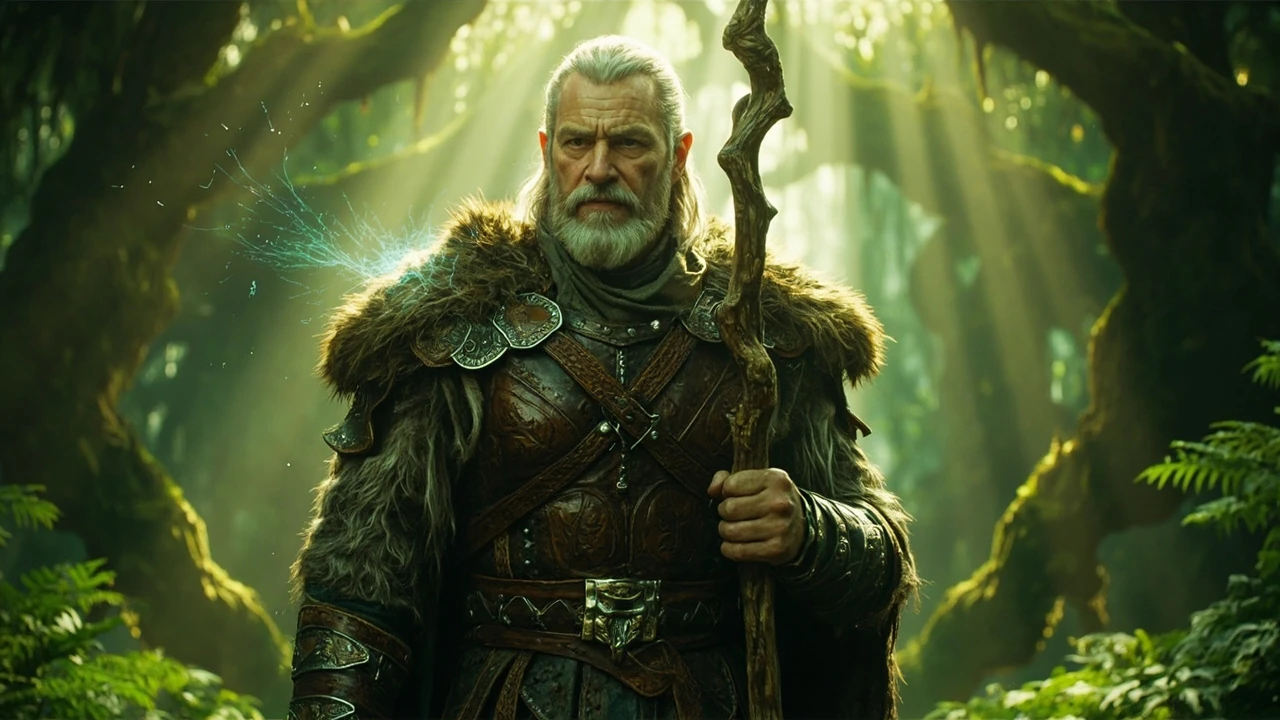
BG3 Halsin: recruitment, build, and role across Acts 1 and 2
Halsin is a tiefling druid of the Emerald Grove, the ancient druid enclave in the Wilderness that serves as the first major hub of Baldur’s Gate 3. He holds the title of First Druid and leads the grove’s inner circle, which puts him in charge of decisions about the tiefling refugees who fled there after Elturel was dragged into Avernus. The party meets him during the goblin raid on the grove, and the path to recruiting him runs through that conflict.
Inside the Forgotten Realms setting, the Emerald Grove functions more like a local chapter of the wider Emerald Enclave than an independent druid nation. Halsin can speak for the grove’s druids, but he cannot bind neighboring circles or settlements to his decisions, and that limit shows up in his dialogue. He negotiates on behalf of his circle, not the region.
From a design angle, Halsin is a wide companion. He is durable, flexible across several roles, and useful in most party compositions, but his personal arc is narrower than companions like Shadowheart, Astarion, or Wyll. His questline runs through the grove and the Shadow Curse region, and his Act 3 presence is supportive rather than plot-driving. Players who plan around that shape get more out of him than players who expect a long personal storyline.
How to recruit Halsin in the Emerald Grove
Recruiting Halsin takes three steps. The order is flexible, but the third step is not optional, and players who skip or mishandle any of them will not see the “join the party” prompt. Halsin stays in the grove as a regular NPC until the conflict is resolved.
- Reach the Emerald Grove. The grove sits on the main road north from the nautiloid crash site. The standard route runs through the Blighted Village and past the goblin camp, then west along the ridge. A southern approach is possible if the party skirts the goblin patrols.
- Free Halsin from the goblin raid. Inside the grove’s inner sanctum, Halsin is held in the druid’s den behind a locked door. The door opens with a key, a lockpick check, or by clearing the goblin leaders and looting the key. Once inside, talk to him and pick dialogue options that side with the druids against the raid.
- Resolve the grove conflict. Halsin will not leave the grove until the player decides what happens to the tiefling refugees. He can be persuaded to wait while the player solves the problem, and he can be temporarily recruited for that one fight, but the full recruitment trigger requires the player to end the conflict in a way Halsin accepts.
The decision the player makes about the grove shapes Halsin’s reaction. Resolving the conflict in favor of the tieflings convinces Halsin that the grove can be defended and allows him to travel with the party. Choosing to attack the grove in the goblins’ favor locks Halsin into the camp as a hostile NPC for the rest of the act. The path of least resistance is to side with the druids and the tieflings, which also aligns with the goals of several other companions later on. For background on how the wider series reached this point, the Baldur’s Gate series entry on Wikipedia traces BioWare’s pausable real-time RPG lineage that BG3 builds on.
What Halsin does differently as a companion
Halsin’s class in the party screen is Druid, and his starting equipment is a quarterstaff, leather armor, and a sling as a ranged option. He has the standard tiefling racial features, including fire resistance, and his stat block prioritizes Wisdom and Constitution. He does not arrive with a unique druid subclass; the player picks one at the appropriate level.
His combat AI tends to favor concentration spells and summons rather than direct damage, which fits his character but means a player who recruits him expecting a frontline fighter will be disappointed. His behavior leans toward Wild Shape in the early game, and the AI uses bear and owlbear forms aggressively when left in autonomous mode.
Three differences set Halsin apart from other druid characters in the game:
- His camp behavior triggers unique events tied to the Shadow Curse region, including a small set of dialogues that progress his personal quest.
- He is openly polyamorous and acknowledges it in camp dialogue, which changes how the romance arc resolves.
- His combat AI uses Wild Shape more aggressively than a custom-built druid would, which means leaving him in AI mode favors beast forms in the early game.
These traits shape how the player manages him. A player who wants him to behave like a custom-built druid needs to switch him to party-member-controlled mode and direct his casting. A player who wants to treat him as a summoned ally can leave him in AI mode and let him hold a frontline position.
Choosing a druid subclass for Halsin
Halsin hits the subclass selection prompt at druid level 2, and the choice mirrors any custom druid. There is no Halsin-specific subclass. The two options that fit his stat block and AI behavior are Circle of the Moon and Circle of the Land. Circle of the Stars exists as a third option in the full release, but it shifts his combat role enough to deserve separate consideration.
Circle of the Moon: the natural fit
Circle of the Moon focuses on Wild Shape combat, with improved beast forms and the Combat Wild Shape feature that lets the druid transform as a bonus action. Halsin’s high Constitution and Wisdom make him an efficient Moon druid, and his AI behavior already favors animal forms. The build path is straightforward: spend combat rounds in animal form, use Wild Shape to soak damage, and use bonus action attacks to apply conditions.
Players who want a hands-off companion will find Moon the easiest choice. Players who want a caster druid will need to manually direct Halsin to use his spell slots, because the AI does not always prioritize a concentration spell over a Wild Shape.
Circle of the Land: the caster path
Circle of the Land gives access to a wider spell list and a recovery mechanic, with a choice of land type at level 2 that grants extra spells. Halsin’s stat block supports a Wisdom-heavy casting build, and the extra spells from the land choice help offset his narrower personal quest. The tradeoff is that his AI will still favor Wild Shape unless the player disables the option, so a Land Halsin requires more active management than a Moon Halsin.
Circle of the Stars: a third option
Circle of the Stars replaces the Wild Shape focus with a starry form and a free Guiding Bolt at level 2, and it supports a constellation-themed casting build. Halsin does not gain any extra roleplay benefits from this subclass, but the casting focus fits a player who wants him to behave like a support caster. The Wild Shape options are still available, just less central.
Practical Halsin druid build for early to mid game
For a player who wants a working Halsin in the first two acts, the stat distribution, level-by-level choices, and equipment approach below are a tested baseline. The numbers are pulled from his in-game stat block and the standard druid progression, and no claim here assumes access to items the player cannot obtain before Act 2.
Starting stats and level priorities
Halsin’s base stat block is fixed at recruitment. The player cannot change his race or base ability scores, but can allocate level-up points using the standard +2 to one, +1 to another, or +1 to three stats system. The recommended priorities are:
- Primary: Wisdom. Druid casting scales with Wisdom, and Halsin starts with a Wisdom of 16. Pushing Wisdom to 18 by druid level 4 gives a meaningful boost to concentration and save DCs.
- Secondary: Constitution. Concentration checks rely on Constitution, and Halsin’s AI will keep him in frontline positions. Constitution should reach 14 by the time the party hits level 5.
- Tertiary: Dexterity. Druid armor caps at medium, so Dexterity only needs to be high enough to improve armor class to medium-armor levels. A starting 14 is acceptable.
- Other stats: Strength, Intelligence, and Charisma can remain at the base 8 to 10 range. No Halsin dialogue check requires a Charisma investment that the player character cannot make instead.
Level-by-level choices
| Druid level | Recommended feature | Notes for Halsin |
|---|---|---|
| 2 | Circle of the Moon | Improves Wild Shape durability, fits his AI |
| 3 | Two 2nd-level spell slots | Heat Metal and Moonbeam are good fit choices |
| 4 | ASI: +2 Wisdom (or +1 Wisdom, +1 Constitution) | Boosts concentration checks |
| 5 | Cone of Cold via elemental wild shape, or 3rd-level slots | Call Lightning is a strong pick for a Moon druid AI |
| 6 | Improved Wild Shape forms | Unlocks more durable beast forms |
| 7 | 4th-level slots | Ice Storm and Polymorph both fit Halsin |
| 8 | ASI: +2 Wisdom to 20, or take a feat | Feat choice depends on party composition |
| 9 | 5th-level slots | Conjure Elemental is a strong option |
| 10 | Final subclass feature | Elemental Wild Shape for Moon, Natural Recovery for Land |
Early equipment and consumables
Early-game druid equipment is constrained. The party can find leather and hide armor in the Emerald Grove and the Blighted Village, and the goblin camp vendors sell a small selection of medium armor. Halsin does not need a specific weapon to function. A focus staff or a component pouch matters more, and the player can buy a basic focus from the druid vendor inside the grove.
Players who want Halsin to last through the Shadow Curse arc should keep a stock of healing potions and an antidote for any party-wide condition. Druids are concentration-heavy, and a single failed concentration check can break a long combat. The game gives several short-rest items that can be used to recover slots, and a Moon druid can afford to spend slots more freely because Wild Shape costs no resource.
Halsin’s role in the Shadow Curse arc
After the grove conflict, Halsin is either a traveling companion or a non-companion ally, depending on how the player resolved the grove. The Shadow Curse is the main quest of Act 2, and Halsin’s role in it depends on that choice. A druid who sided with the grove engages with the curse directly, because he is investigating the corruption spreading south of the mountain pass. A druid who stayed in the grove only contributes information through dialogue, not as a party member.
Inside the Shadow Curse region, Halsin unlocks a small set of camp conversations that progress his personal arc. The conversations revolve around the curse’s effect on the wild, on druid circles, and on the player character’s own tadpole situation. He is one of the more vocal companions about the ethics of using the tadpole powers, and his input shapes how the party can resolve some of the morally ambiguous encounters in the region.
Players who want Halsin in the party for Act 2 should also be aware that he has a high-affinity trigger in that act that affects his romance availability. The trigger is straightforward: any party member who has not resolved a personal conflict with the protagonist can engage with Halsin’s camp dialogue tree. Players who are already locked into a single-companion romance will see a soft gate, but Halsin will not block the relationship.
Halsin romance, approval, and camp behavior
Halsin’s romance is optional, open to any party member regardless of gender, and only available if the player meets a set of camp and approval conditions. The romance arc is shorter than the arcs of other companions, and the explicit content is limited. The arc exists to acknowledge the character, not to drive the plot.
Approval-wise, Halsin approves of actions that defend nature, protect the innocent, and resolve conflicts without unnecessary violence. He disapproves of poisoning the grove, massacring the tieflings, and wanton destruction of wild areas. His approval thresholds for romance are lower than for companions like Shadowheart or Karlach, which makes the romance easier to enter but harder to keep exclusive.
The key romance trigger is a camp event that occurs after the Act 2 climax. If the player has Halsin in the active party, has not committed to an exclusive romance with another companion, and has resolved Halsin’s camp dialogue to a specific stage, the trigger fires. Missing the trigger is easy, because the conversation can resolve without the player realizing it was the romance option.
Sources for checking: the official Baldur’s Gate 3 site and the Halsin reference at BG3.wiki.
What happens if Halsin is not recruited
A player who leaves Halsin in the grove, either by choice or by failing one of the recruitment steps, loses a permanent party slot but does not lock out the rest of the game. Halsin remains a non-companion NPC in the grove for Act 1, and his dialogue remains available if the party returns. In Act 2, he can appear as a non-companion ally during a specific quest, but the player does not get a full party member.
The main consequence of skipping Halsin is a narrower druid option in the early game. The party still has access to Jaheira later, but Jaheira is a multiclass druid who behaves differently from a pure druid. Players who want a Moon druid in the party will miss Halsin if they skip him, because the other available druid options are limited.
A secondary consequence is a change to the camp event pool. Halsin triggers unique events that other companions do not, and skipping him removes those events. The events are not plot-critical, but they are part of the game’s broader companion system, and players who want to see the full camp experience will want Halsin in the party at least until Act 2.
Common mistakes with Halsin
Players new to Halsin tend to make the same handful of mistakes. The list below is ordered by the cost of the mistake, not by frequency.
- Failing to resolve the grove conflict. Halsin will not leave until the conflict is over. Leaving the conflict unresolved and moving on is the most common way to lose Halsin as a permanent companion.
- Forgetting to talk to Halsin after the conflict. The recruitment prompt is a dialogue option, not an automatic trigger. The player must choose the right line to convince Halsin to travel with the party.
- Putting Halsin on the frontline in Act 2. The Shadow Curse region has several encounters where positioning matters, and a druid in animal form is more vulnerable than a caster. Switching Halsin to a support role for the harder fights is safer.
- Ignoring Halsin’s personal quest. Halsin’s quest is shorter than other companions, but missing it removes his Act 2 camp content. The quest is resolved through camp dialogue, not through exploration.
- Leaving Halsin in camp during boss fights. Halsin’s AI is not always optimal for boss fights, but a Moon druid in Wild Shape is a strong frontline soak. Pulling him out of camp for boss fights is generally a good idea.
How Halsin compares to other druid companions
The druid roster in the game is small, and Halsin is the only pure druid available in Act 1. Jaheira joins in Act 2 as a druid-rogue multiclass, and a custom character can be built as a druid, but those are the only options. The table below compares Halsin, Jaheira, and a custom Circle of the Moon druid built to a similar level, on the dimensions that matter most for party composition.
| Trait | Halsin | Jaheira | Custom Moon druid |
|---|---|---|---|
| Recruitment act | Act 1 | Act 2 | Character creation |
| Class | Druid | Druid/Rogue multiclass | Druid |
| Default subclass | None, player chooses | Circle of the Land | Player chooses |
| Personal quest | Short, Act 1 to Act 2 | Longer, tied to a major plot | None built in |
| Romance availability | Yes, polyamorous | Yes, restricted to compatible player characters | N/A |
| Combat AI behavior | Favors Wild Shape and summons | More flexible, can sneak attack | Depends on player control |
| Camp dialogue volume | Moderate | High | None unless player triggers it |
The comparison shows that Halsin is a strong early-game option, but the player should think about who replaces him in Act 3. If the player keeps Halsin through the city acts, the slot is occupied. If the player wants a more plot-driven companion, they can switch him out for Jaheira or a custom character once the grove is resolved.
Party compositions that work well with Halsin
Halsin is most effective in parties that need a Wild Shape frontline, a concentration caster, or a summoning support. The compositions below are tested against the harder fights in the early and mid game, but they are not the only options.
- Frontline anchor: Halsin in Wild Shape, a fighter or paladin in heavy armor, a cleric for healing, and a ranged rogue or wizard for damage. This is a balanced party that works for most encounters.
- Summoning core: Halsin as a summoner, a wizard with summoning spells, a cleric with animate dead access, and a tank. This composition chews through Act 2 fights but is vulnerable to anti-summon effects.
- Support caster: Halsin in a casting role, two other casters, and a melee frontliner. This composition works if the player is willing to micro-manage Halsin’s spell selection.
The least effective compositions for Halsin are those that already have a dedicated concentration caster and a dedicated Wild Shape user. A party with both Karlach and a custom druid has a redundant role, and Halsin becomes a slot the player does not need to fill.
Performance and technical considerations for Halsin
From a game technology perspective, Halsin is a standard NPC with a standard AI script. He does not have unique pathfinding, special encounter triggers, or hidden quest logic. He is, however, one of the more memory-intensive NPCs in Act 1, because he has several camp dialogue trees and unique animations. Players with lower-end hardware may see a small frame cost when Halsin is in the active party and the camp is in view, but the cost is not unique to Halsin; it applies to most companions with full dialogue trees.
On the patching side, Halsin has been a target for several hotfixes since release, mostly around the romance trigger and the camp event timing. Players who started a save before the romance fix and have Halsin in the party may need to reload an earlier save to trigger the romance. The same applies to the camp event that progresses his personal quest; an older save may have the event in the wrong state.
For players running the current build, Halsin’s behavior is stable. There are no known quest-blocking bugs specific to Halsin in the current patch, and the recruitment and personal quest triggers work as intended.
How Halsin fits into a broader run
Players who plan their party across the full game should think of Halsin as a temporary slot for Act 1 and Act 2, with the option to keep him through Act 3 if they value the camp content. The party composition that works best for the city acts tends to include characters with specific city-oriented quests, and Halsin is not one of them. The druid is more useful in the wilderness.
A practical plan is to keep Halsin in the party until the Act 2 climax, resolve his personal quest, and then decide whether to swap him out for a city-oriented companion. Swapping does not lock out Halsin’s camp events; it just removes him from the active party. The events still trigger when the party returns to camp.
Players who want Halsin to remain in the party through the end of the game should plan the rest of the party around his needs. A party of Halsin, Shadowheart, Astarion, and Karlach covers most of the game’s quest content, with a few gaps. Filling those gaps with a hired mercenary or a summoned creature works in the late game but is less efficient than having a balanced party.
Frequently asked questions
Where do you find Halsin in the Emerald Grove?
Halsin is held in the inner sanctum of the Emerald Grove, behind a locked door in the druid’s den. Players reach the grove by traveling north from the nautiloid crash site, through the Blighted Village, and along the ridge past the goblin camp. The fastest route is to clear the goblin camp, then enter the grove from the north. The locked door opens with a key obtained from a goblin leader, with a successful lockpick check, or by killing the leaders and looting the key.
Can Halsin die permanently in the game?
Halsin can die in combat, and a dead companion stays dead unless the player revives him through a Withers resurrection, a Scroll of Revivify, or by reloading an earlier save. He is not protected by plot armor once he joins the party, which means the player should be careful with his positioning in the harder fights. In Act 2, several encounters can one-shot a non-frontline druid, and the player should keep Halsin in Wild Shape or behind cover during those fights.
Does Halsin approve of using the astral tadpole powers?
Halsin is one of the more vocal companions about the ethics of the tadpole powers, and he generally disapproves of consuming more than the initial tadpole. His disapproval is mild compared to companions like Wyll or Karlach, but the player can trigger unique dialogue by refusing the powers in his presence. The approval change is small, but the dialogue is part of his character and is worth seeing at least once.
Can Halsin be permanently locked out of the romance?
Yes, the romance arc can be locked out by committing to an exclusive romance with another companion before Halsin’s Act 2 trigger, by failing to resolve his personal quest, or by missing the camp conversation that progresses the arc. The lockout is recoverable by reloading a save, but it cannot be triggered in the same playthrough if the player has already chosen an exclusive romance path.
What is the best Halsin build for honor mode?
In honor mode, the safest Halsin build is a Moon druid focused on Wild Shape and concentration spells. The Wild Shape forms give the druid a buffer against the harder one-shot mechanics, and the concentration spells give the party a way to handle area control. A Land druid is also viable but requires more careful spell selection, because the AI will not always use the most efficient spell in a given fight.
Can Halsin be used as the party healer?
Halsin has access to healing spells, but his spell list is druid-only, and druid healing is weaker than cleric healing. He can function as a backup healer, especially with spells like Healing Spirit or Heal, but he should not be the party’s primary healer in a long fight. A dedicated cleric companion, or a custom cleric, will out-heal Halsin in most situations.
Does Halsin have unique interactions with Karlach or Wyll?
Yes, Halsin has a small set of camp dialogues with both Karlach and Wyll that are unique to the combination. The Karlach dialogue is part of her personal quest and is unlocked by having Halsin in the active party when Karlach’s Act 2 climax occurs. The Wyll dialogue is shorter and is tied to the Mizora subplot. Both dialogues are worth seeing at least once, and they do not require any specific approval level.
Can Halsin be swapped out and back in without losing his quests?
Yes, Halsin’s personal quest progress is saved even if he is not in the active party. The party can swap him out, complete other content, and swap him back in to continue his quest. The quest trigger that requires Halsin in the party is the camp event in Act 2, which fires regardless of whether he is in the active party, as long as he is in the camp.
What level should Halsin be for the Ketheric fight?
Halsin should be at least druid level 9, ideally druid level 10, for the Ketheric Myrkul fight. The fight has heavy area-of-effect damage, anti-summon mechanics, and a phase that punishes concentration. A level 9 or 10 druid has the spell slots and the Wild Shape forms to handle the fight without burning all of the party’s resources. Lower levels are possible, but the player should expect to reload at least once.
Is Halsin worth keeping in the party through the end of Act 3?
Whether Halsin is worth keeping depends on the player’s priorities. He is a strong combat ally through the end of the game, but his personal quest ends in Act 2, and his Act 3 camp content is limited. Players who want a strong combat ally and are happy with shorter companion arcs should keep Halsin. Players who want longer arcs and more Act 3 dialogue should swap him out for a companion with more content.

Leave a Reply